

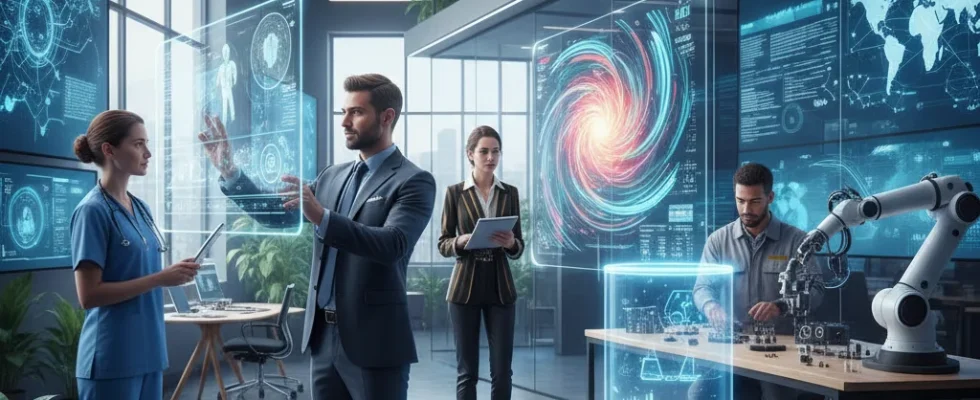
AI in the Workplace: Which Jobs Are Changing the Most?
Artificial intelligence isn’t just a buzzword anymore; it’s a powerful force actively reshaping industries and job functions across the globe. You might be wondering how AI in the workplace will affect your career or your industry. The truth is, AI is already here, streamlining processes, automating tasks, and creating new opportunities while redefining existing roles. This article will break down which jobs are seeing the most significant shifts and what you can expect as this technological revolution continues.
Advertisements
The Rise of Automation: Repetitive Tasks First
One of the most immediate impacts of AI in the workplace is the automation of repetitive, rule-based tasks. Think about the countless hours spent on data entry, customer service inquiries, or routine administrative work. AI, particularly through machine learning and natural language processing, excels at these functions, often with greater speed and accuracy than humans.
For example, in finance, AI-powered algorithms can process vast amounts of financial data, identify trends, and even detect fraud much faster than human analysts. This doesn’t necessarily mean job elimination, but rather a shift in focus. Financial professionals can now dedicate more time to strategic planning, complex problem-solving, and client relationship management, leveraging AI as a powerful assistant rather than a replacement.
Similarly, administrative roles are evolving. AI virtual assistants can schedule meetings, manage emails, and organize documents, freeing up human assistants to take on more complex project coordination and executive support tasks. This shift requires a different skill set, emphasizing oversight, critical thinking, and collaboration with AI tools.
Creative & Analytical Roles: Enhanced, Not Replaced
While some fear AI will take over creative and analytical jobs, the reality is often more nuanced. Instead of outright replacement, AI is enhancing human capabilities in these fields. For graphic designers, AI can generate initial design concepts, suggest color palettes, or even automate tedious image editing tasks. This allows designers to focus on the higher-level creative vision and client communication.
In marketing, AI analyzes consumer behavior data, predicts market trends, and personalizes ad campaigns with unprecedented precision. Marketing professionals are then better equipped to craft compelling strategies based on deep, AI-driven insights. Their role shifts from data crunching to interpreting AI outputs and applying human creativity and empathy to connect with audiences.
Even in fields like journalism, AI can assist with research, summarization, and even drafting basic news reports. Human journalists can then concentrate on investigative reporting, interviewing, and adding the critical human perspective, analysis, and storytelling that AI currently lacks. The collaboration between human and AI in these sectors is creating a new paradigm for productivity and innovation.
Healthcare & Education: Aiding Professionals
The impact of AI in the workplace extends deeply into critical sectors like healthcare and education. In healthcare, AI is revolutionizing diagnostics, treatment planning, and drug discovery. AI algorithms can analyze medical images (like X-rays and MRIs) to detect anomalies with remarkable accuracy, sometimes even surpassing human capabilities. This doesn’t replace radiologists but provides them with a powerful second opinion and helps prioritize urgent cases.
AI also assists in personalized medicine, analyzing a patient’s genetic data and medical history to recommend the most effective treatments. Doctors, nurses, and other medical professionals can leverage AI to improve patient outcomes, reduce administrative burdens, and dedicate more time to direct patient care and empathy. The human touch remains irreplaceable in healthcare, but AI can make that touch more informed and efficient.
In education, AI-powered platforms can personalize learning experiences for students, identify areas where they struggle, and even grade certain types of assignments. Teachers can use AI to manage administrative tasks, create customized lesson plans, and provide more targeted support to individual students. This frees up educators to focus on mentorship, critical thinking development, and fostering a dynamic classroom environment.
Manufacturing & Logistics: Smartening Operations
The manufacturing and logistics industries have long been at the forefront of automation, and AI is taking this to the next level. AI-powered robots are becoming more sophisticated, capable of performing complex assembly tasks, quality control inspections, and handling materials with greater precision and adaptability. This leads to increased efficiency, reduced waste, and improved safety in factories.
In logistics, AI optimizes supply chains, predicts demand, and plans the most efficient delivery routes, reducing costs and environmental impact. Autonomous vehicles, guided by AI, are also beginning to transform transportation. While some manual labor roles might be reduced, new jobs are emerging in managing, maintaining, and programming these advanced AI systems. The focus shifts from manual execution to oversight, data analysis, and system optimization.
These changes require workers to develop new skills, such as robotics maintenance, data interpretation, and understanding AI interfaces. The future of manufacturing and logistics will be a blend of human ingenuity and AI-driven efficiency.
The Evolving Skillset for the AI Era
As AI in the workplace continues its integration, the demand for certain skills will inevitably shift. While technical skills like AI development, data science, and machine learning engineering are clearly on the rise, so too are uniquely human capabilities. Critical thinking, problem-solving, creativity, emotional intelligence, and complex communication skills will become even more valuable. These are areas where AI currently falls short and where humans excel.
Adaptability and a willingness to engage in continuous learning are also paramount. The jobs of tomorrow will require individuals to work alongside AI, leveraging its strengths to amplify their own. This means understanding how to use AI tools effectively, interpret their outputs, and even identify their limitations. The workforce that embraces lifelong learning will be best positioned to thrive in this evolving landscape.

Companies are also investing in reskilling and upskilling programs to prepare their employees for these changes. The goal isn’t to replace humans with AI, but to empower humans with AI, creating a more productive, innovative, and potentially more fulfilling work environment.
Quick Takeaways:
- AI is automating repetitive tasks across industries, freeing up human workers for more complex work.
- Creative and analytical roles are being enhanced by AI, leading to increased efficiency and new possibilities.
- New skills like AI literacy, critical thinking, and adaptability are becoming crucial for success in the evolving job market.
FAQ:
- What jobs are most at risk from AI?
- Jobs involving highly repetitive, predictable, and rule-based tasks are most susceptible to automation, such as data entry clerks, assembly line workers, and some administrative support roles. However, these roles often evolve rather than disappear entirely.
- Will AI create new jobs?
- Absolutely! AI is already creating new roles like AI trainers, prompt engineers, AI ethicists, data scientists, and robotics engineers. It also elevates existing roles by requiring more strategic oversight and human-centric skills.
- How can I prepare for AI in the workplace?
- Focus on developing uniquely human skills such as creativity, critical thinking, emotional intelligence, and complex problem-solving. Also, learn to use AI tools effectively and stay updated on technological advancements relevant to your industry.
Conclusion
The integration of AI in the workplace is not a distant future but a present reality. While it’s natural to have questions and concerns, understanding how AI is transforming various job roles can empower you to adapt and even thrive. Embrace lifelong learning, cultivate your uniquely human skills, and look for opportunities to collaborate with AI tools to enhance your productivity and creativity. The future of work is about synergy between human intelligence and artificial intelligence, creating a dynamic and innovative environment for everyone.